
Evgenia Faliaridou is a visual artist based between Thessaloniki and Heraklion. She holds a degree from the School of Fine Arts, Aristotle University of Thessaloniki (BA & Integrated Master), and an MA in Audiovisual Arts in the Digital Age from Ionian University. She has taught at the School of Fine Arts, Aristotle University of Thessaloniki, in the1st Painting Studio and the Industrial Design Lab (2021–2025), and currently teaches Visual Arts in public schools.
Her work spans painting, drawing, and installation, engaging both analog and digital media. Through an abstract visual language, she explores the shifting presence of the human figure within spatial and temporal contexts, focusing on processes of transition, coexistence, and transformation. Her practice reconfigures painterly form, generating visual fields that invite open-ended interpretation.
Faliaridou has presented her work in solo exhibitions and over 40 group exhibitions and festivals internationally. Selected presentations include MOMus – Experimental Center for the Arts, Thessaloniki; Thessaloniki Concert Hall; the Numismatic Museum of Athens; MAKK – Museum für Angewandte Kunst Köln; the Folklore Museum of Larissa; the Municipal Gallery of Ioannina; and the Ionian University Audio-Visual Arts Festival, among others.
Her work has been featured in exhibition catalogues and across print and digital platforms.
Website : tzenifaliaridou.com
mail: tzenifaliaridou@gmail.com
The relation as a structure, between black and white, presence and absence, memory and recognition, seeing and perception, the artwork and the viewer.
Forms seem to pass before us like fleeting images that appear only for an instant and begin to dissolve before they can fully take shape. We never remember an image in its entirety; we remember fragments, relations, traces. The gaze continually reconstructs what is absent, allowing a different form to emerge each time. Perhaps this is why the work does not ask the viewer to recognize an image, but to participate in its coming into being. In “Relation”, the image is constituted through the relationships that unfold among the individual elements of the composition. The painted and the unpainted, the complete and the fragmentary, function as interdependent parts of a shared structure. Form does
not pre-exist these relationships; it emerges through them, in the interval between what is revealed and what is implied. White is not a neutral background but an active component of the composition, as a visual complement, creating intervals within which perception extends the form beyond the limits of the painted surface.
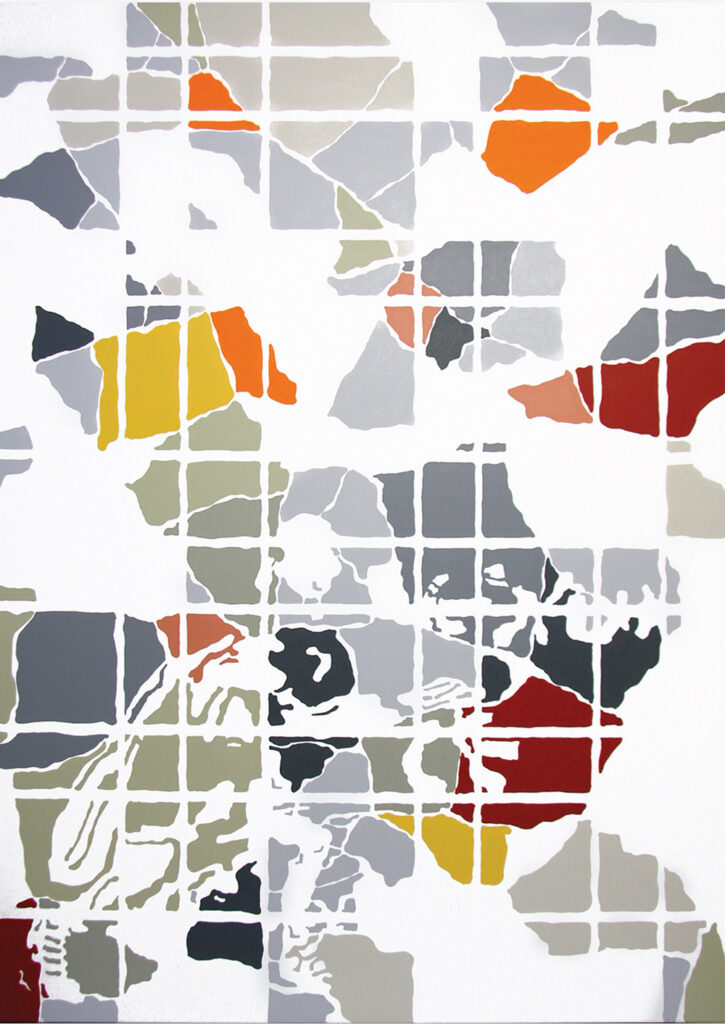
Relation [I], 2019, 140 x 100 cm, acrylics paint on prepared cotton fabric
Σχέση [I], 2019, 140 x 100 εκ., ακρυλικά χρώματα σε προετοιμασμένο ύφασμα.
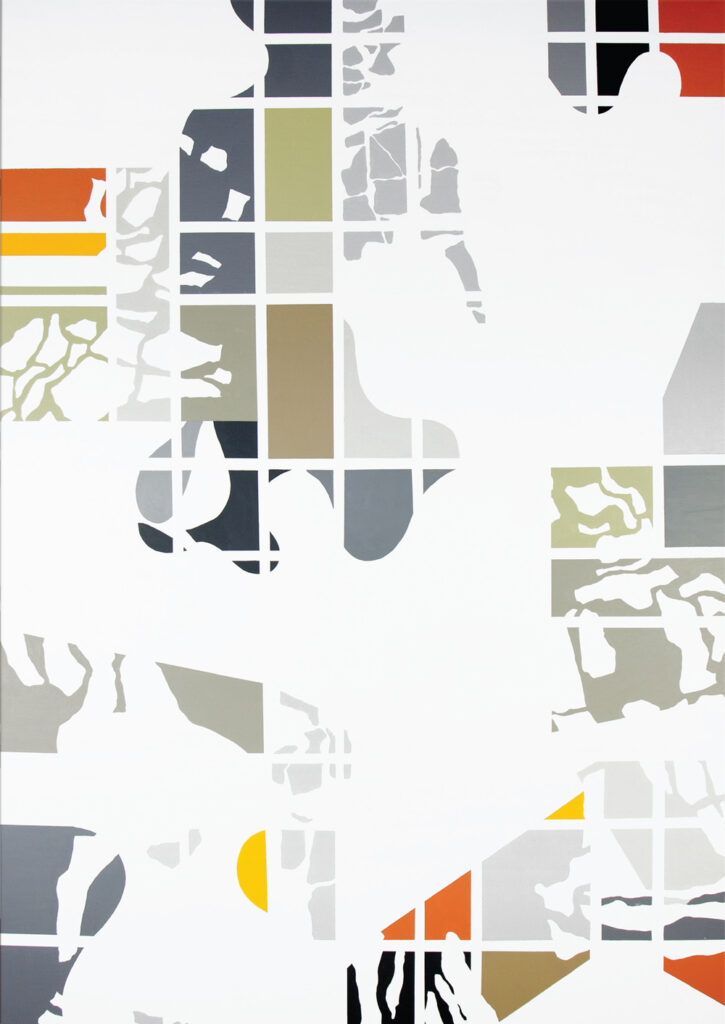
Relation [IΙ],, 2019, 140 x 100 cm, acrylics paint on prepared cotton fabric.
Σχέση [IΙ], 2019, 140 x 100 εκ., ακρυλικά χρώματα σε προετοιμασμένο ύφασμα.